
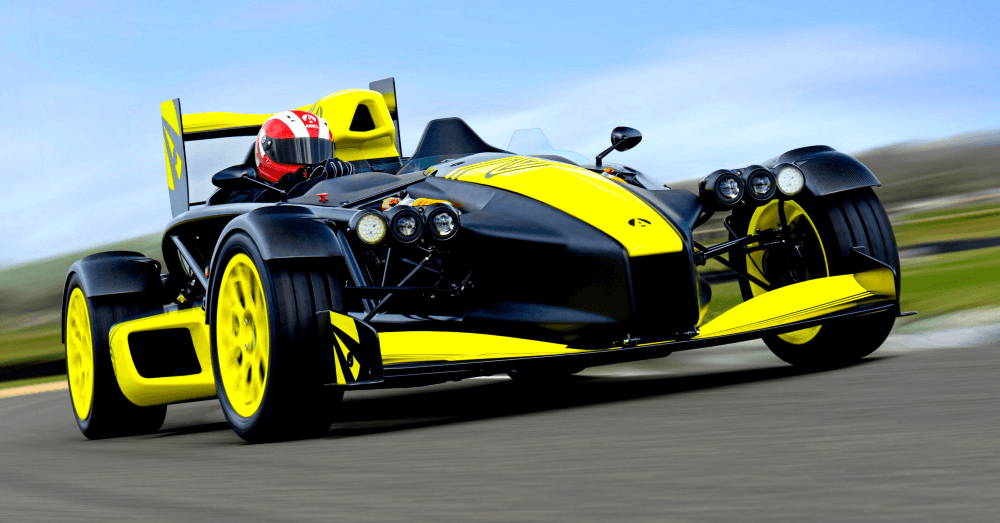
Twenty-five years after the original Atom shook up the lightweight sports car world, Ariel has built something completely unhinged to celebrate. The Atom 4RR is the fastest, most powerful, and most uncompromising version the tiny British company has ever put together, and it wears a bespoke yellow anniversary livery to prove it.
- Hand-built Honda-based 2.0-liter turbo four making 525 bhp and 550 Nm
- 0 to 62 mph in 2.4 seconds, 100 mph in 5.1, top speed 175 mph
- Starts around $279,000, built to order in Crewkerne, England
A Hand-Built Honda Heart
The whole project revolves around a motor that takes more than 100 hours to assemble by hand. Its foundation is the tough and reliable 2.0-liter four-cylinder Honda K20C Type R unit, but almost every significant internal and external component gets replaced, upgraded, or re-engineered to motorsport specification. Ariel fits closed-deck sleeves, Ariel-specific forged pistons and connecting rods, a revised cylinder head and port geometry, alloy valves with upgraded springs and guides, new camshafts, a larger turbo that generates 1.7 bar of peak boost, and 1,400-cc fuel injectors to push output to a genuinely silly place.
The final tally? 525 bhp, 550 Nm, and an 8,200 rpm limit. Drivers can also dial things back using cockpit-adjustable maps. Map 1 gives you 400 bhp and 380 Nm, Map 2 bumps that to 500 bhp and 450 Nm, and Map 3 unleashes the full 525 bhp and 550 Nm. Every engine is run in on a dyno before it leaves the factory, and each buyer even gets their car’s individual power graph.
Numbers That Embarrass Hypercars
Because the 4RR weighs so little, the on-paper numbers read like a typo. A curb weight of just 1,474 pounds allows the 4RR to scoot from zero to 62 mph in 2.4 seconds and to 100 mph in 5.1 seconds, making it the quickest Atom production model yet. Top speed lands at 175 mph, which is plenty when you’re sitting inches off the tarmac with no roof, no doors, and no windscreen in the way.
Put another way, the power-to-weight figure works out to roughly 780 hp per ton. That kind of math puts the Atom 4RR ahead of most seven-figure hypercars on paper. A modern Nissan GT-R Nismo, for reference, makes about 600 hp but weighs more than twice as much, which tells you everything about Ariel’s stubborn commitment to subtracting mass rather than piling on horsepower for its own sake.
Gearbox, Brakes, and Aero Built for Circuit Combat
Power gets to the rear wheels through a proper race transmission. A Quaife six-speed sequential gearbox with lightweight drive discs, motorsport differential, and pneumatic paddle shift handles shifting duties, and you only need the clutch when pulling away from rest.
Braking hardware matches the engine’s ambition. AP Racing two-piece ventilated rotors are clamped by four-piston calipers, with driver-selectable ABS offering 11 settings (including “off”). The 12.2-inch rotors are the largest that fit within the Atom’s staggered 16-inch front and 17-inch rear wheels, which wear Yokohama A052 tires sized 195/50R16 in front and 255/40R17 in back.
Suspension is fully adjustable Öhlins twin-tube dampers with chromoly wishbones, and the carbon bodywork has been reworked around the engine. Carbon-fiber side pods are based on the ones developed for the Atom 4R, but with additional cooling channels for the engine and gearbox. A huge rear wing, other aero elements, and the mud guards are made of carbon fiber as well.
A 25-Car Run With a Visit to Crewkerne
Only 25 examples will be built, matching the model’s 25th birthday. Each Atom 4RR is built to order in Crewkerne at a starting cost of $279,000. Customers focused on track driving can option theirs with a plated differential, electronically controlled dampers, a motorsport-approved roll cage, and even on-board air jacks. Ariel also invites buyers to the factory to spec their car with the people who will actually build it, and optional driver training with Ariel’s chief test driver is on the menu.
There is one catch for American enthusiasts. While the 4RR is street-legal in the UK, no Atom meets U.S. Federal Motor Vehicle Safety Standards, so they’re not technically road-legal here. Ariel North America does sell them for off-road use only. Translation: if you want to drive one home from the track, you’ll need a trailer and a tolerant neighborhood. The trade-off is a car that, on a circuit, will likely humble almost anything else at any price.
