
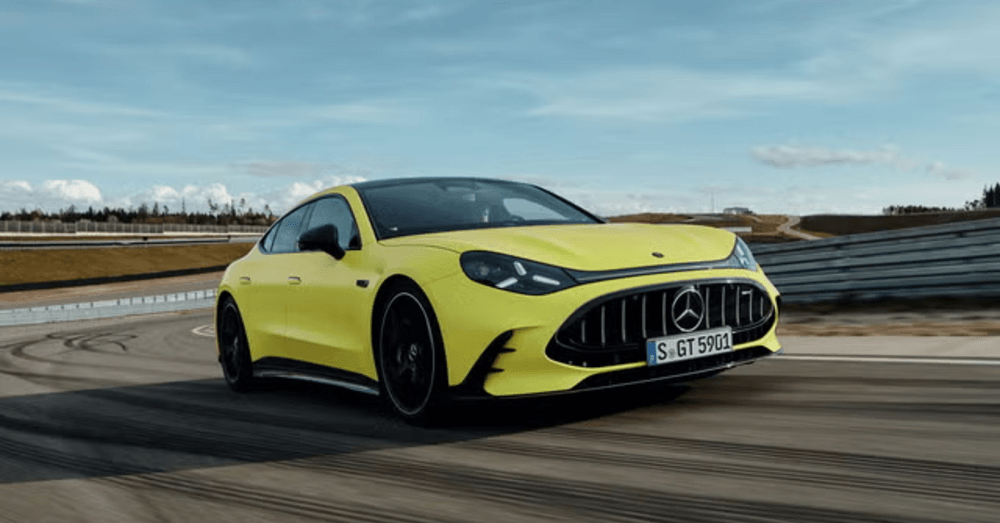
Affalterbach is doing something wild with its first ground-up electric performance car. The upcoming Mercedes-AMG GT 4-Door EV will rumble, snarl, and even pretend to swap gears, all while three Yasa axial-flux motors fire well over 1,300 hp through the rear tires. It’s an electric AMG built to feel like a combustion AMG, and from early prototype drives, the trick seems to be working.
- Three axial-flux Yasa motors target output of 1,341+ hp on an 800-volt AMG.EA platform
- Synthesized V8 soundtrack pairs with simulated gear shifts triggered by steering wheel paddles
- Aimed squarely at the Porsche Taycan Turbo GT and Lucid Air Sapphire
A Synthetic V8 That Actually Sells the Illusion
The headline trick is the sound. In a new development video, Mercedes-AMG F1 driver Doriane Pin engages Sport+ mode and pins the throttle from a standstill, releasing the synthesized V8 noises the production car will make. The audio is layered, throaty, and clearly tuned to evoke the brand’s hand-built 4.0-liter twin-turbo eight.
What sets it apart from rivals is the addition of fake shift points. AMG has worked in simulated upshifts so the car barks its way up to a pretend redline as it runs through imaginary gears, just like a combustion GT 4-Door would. A synthetic sequential shift function adds another layer of character, operated via steering wheel paddles that mimic shifting through a conventional gearbox. It’s artificial but effective, adding a sense of cadence.
The drama isn’t only acoustic. A transducer in the seat delivers vibrations that rise and fall with throttle load, in the manner of a V8, so it’s not simply an acoustic overlay. It recreates the rhythm of an engine in both sound and sensation, tying driver inputs more closely to the car’s responses. A centrally mounted rev counter reinforces the effect, its needle sweeping in step with the rising and falling vibrations.
Tri-Motor Yasa Power Means Serious Performance
Under the bodywork sits hardware that should match the theater. The Mk2 GT 4-Door Coupé is the first AMG model based on the AMG.EA platform, a chassis developed from scratch specifically for performance. Its drivetrain uses three axial-flux motors, two at the rear and one up front, working through a single-speed transmission to all four wheels.
Developed with British firm Yasa, those compact, disc-shaped motors are smaller, lighter, more power-dense, and faster-responding than conventional radial-flux units. Each rear motor is controlled independently, so torque can be varied not just front to rear but also across the rear axle. That arrangement also opens the door to genuine drifting. With one motor for each rear wheel, the new AMG EV gets very precise torque vectoring, and the axial-flux design keeps the motors small while staying power-dense.
Output numbers point to a hypercar-grade brawler. The high-performance EV inspired by the AMG GT XX concept is expected to make over 1,341 horsepower (1,000 kW), reined in by a hydraulic composite braking system that pairs front carbon-ceramic brakes with rear steel brakes. Add the AMG Active Ride Control air suspension with semi-active roll stabilization, and you get a sedan that should slide on ice and lap a circuit with equal commitment.
Built to Hunt the Taycan Turbo GT
AMG isn’t shy about its target. Mercedes-AMG is going electric with a bespoke four-door model that will rival the Porsche Taycan, and the new EV promises to bring the typical AMG experience, including simulated V8 engine noise and gear shifts, plus a willingness to go sideways. Pricing should land near the Porsche, with estimates of roughly $200,000 in the US, below the Porsche Taycan Turbo GT at $210,000 and the Lucid Air Sapphire at $249,000.
The car has also proven its endurance bona fides. The GT XX engineering mule covered 24,901 miles in just over seven days at an average of more than 186 mph, a record-setting blitz that helped validate the cooling, battery, and motor stack for sustained high-load use.
Why Fake Shifts Matter on an EV
Some purists will roll their eyes at piped-in noise, but there’s a real engineering case for it. Fake gearshifts make sense for a performance EV, especially when paired with a fake engine noise. Without the simulated gearbox, you’d get something like the Dodge Charger Daytona, which sounds like its fake V8 is connected to a CVT. AMG’s approach uses pre-programmed torque interruptions, so the car briefly pauses thrust at each “shift,” giving the driver tactile cues that pure linear EV acceleration lacks.
The Hyundai Ioniq 5 N proved this formula could be addictive. AMG is now applying the same logic at the supercar level, with hardware that’s far more sophisticated and a price tag to match.
What to Watch as Launch Nears
Prototype testing has wrapped on snow and ice in Sweden, with brake-cracking laps already logged at the Nürburgring. A 2027 model-year reveal looks likely, and an SUV-shaped sibling is expected to follow on the same AMG.EA bones. If the production car delivers on the prototype’s promise of synthesized V8 sounds, real drift angles, and Yasa-driven shove, AMG may have finally cracked how to make an electric performance sedan feel emotional rather than appliance-like.
