
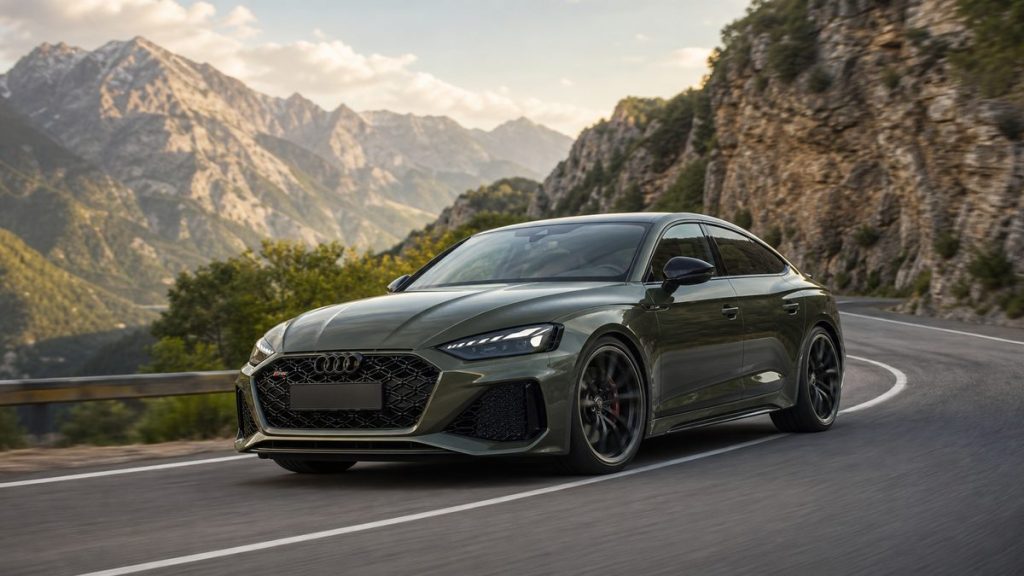
Audi Sport has a reputation problem it’s been carrying for years. Its fast sedans go quickly and stop well, and plenty of drivers still describe them as clinical. The next RS 5 arrives with 630 horsepower and a plug-in hybrid setup, but the hardware worth paying attention to sits at the back of the car.
- The plug-in hybrid RS 5 sedan makes 630 horsepower, with Audi quoting 3.6 seconds to 62 mph.
- A new electromechanical torque-vectoring rear axle moves power side to side rather than pinching a brake to fake rotation.
- Electric assist sharpens throttle response, which shows up in everyday driving more than any stopwatch number does.
Why the Hybrid Part Actually Helps
Six hundred thirty horsepower is a serious figure for a compact sport sedan. It’s also getting harder to be impressed by peak output in this class, because almost everything at this price makes enough power to humble a proper sports car from ten years ago. What separates these cars now is how fast the power arrives once you ask for it.
An electric motor doesn’t wait for boost to build or for a gearbox to sort itself out. It answers right away. Combine that with a turbocharged engine and the small delay that used to sit between your right foot and forward motion mostly closes up. Squeeze the throttle partway through a corner and the car should move on your timing instead of a beat behind it. That response also places the sedan within Audi’s broader plug-in hybrid performance direction, where electrification serves speed and character rather than efficiency alone.
The Rear Axle Is the Real Story
Torque vectoring has turned into one of those phrases marketers use loosely, so the distinction is worth spelling out.
Lots of performance cars imitate the effect by grabbing an inside brake to tuck the nose into a turn. That approach works, but it sheds speed and relies on the friction brakes. An electromechanical torque-vectoring rear axle does something different. Audi’s technical overview of Dynamic Torque Control says the system can create torque differences at the rear wheels in 15 milliseconds, including on throttle, off throttle, and under braking. That lets the outside rear wheel help rotate the car rather than asking an inside brake to drag it into line.
That’s a difference you feel through your hands long before it turns up in any data log. For an all-wheel-drive sedan hauling hybrid hardware around, real authority at the rear axle is what keeps the whole thing from feeling nose-heavy and reluctant to turn.
Reading That 3.6-Second Claim
One clarification, because this gets muddled constantly. Audi’s 3.6-second figure covers 0 to 62 mph, the European standard, not the 0 to 60 mph number American buyers compare against. A 0 to 60 time lands a little quicker. So if you’re lining the RS 5 up against domestic rivals in a spreadsheet, you aren’t measuring the same thing.
Which gets at the bigger problem with shopping this segment on paper. The spreads between these cars have shrunk to margins no driver can register on a public road. Two tenths in a straight line is noise. How a car behaves in the first few degrees of steering, or how it settles when you lift mid-corner, is something you notice on every drive.
That is the opening Audi has against the BMW M3. The BMW’s reputation rests on communication and chassis balance, not merely its launch time. The RS 5 does not need to erase every numerical difference to answer it. If the new rear axle gives this all-wheel-drive sedan genuine rotation and clearer control at the limit, Audi Sport can finally make its case through feel instead of another spec-sheet win.
What to Pay Attention to Behind the Wheel
Skip the stoplight launch. It’ll feel great and teach you little. On a closed course, watch two things instead: does the throttle respond the moment you ask, and does the rear axle help turn the car or simply hold on? Those answers will decide whether this RS 5 deserves its place beside the class benchmark more than any number printed on a window sticker.
