
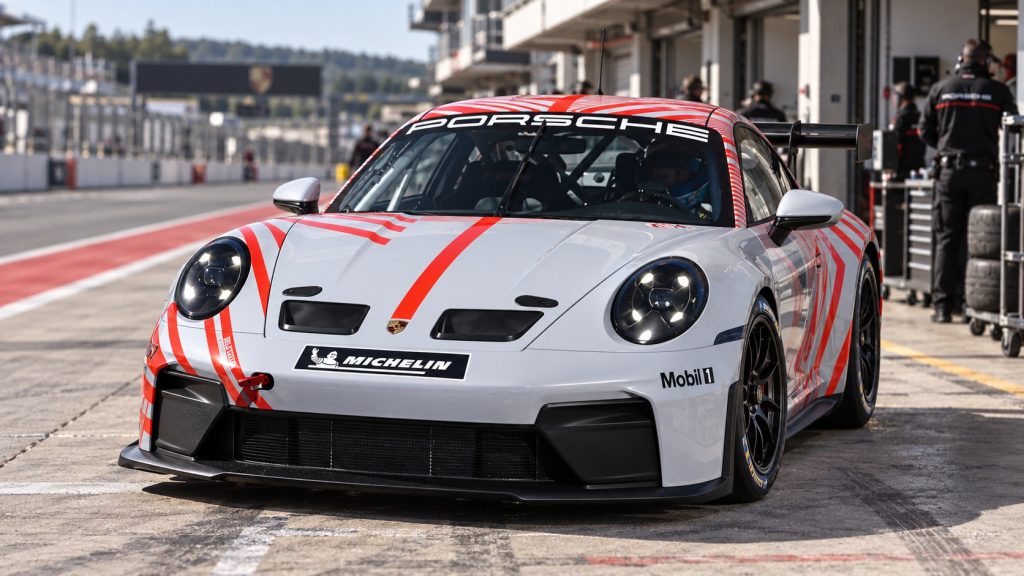
People like to call the Porsche 911 GT3 a race car for the road. It comes close, but it still has treaded tires, a full interior and suspension built to handle potholes. So Porsche took a GT3, stripped out everything a track doesn’t need and built the 911 Challenge. It’s the brand’s new first step into GT racing, and early drives suggest it may be the most fun 911 yet.
- The 911 Challenge replaces the Cayman GT4 Clubsport as Porsche’s entry-level race car and joins the UK’s Porsche Carwow Sprint Challenge from 2027.
- It uses the GT3’s 4.0-liter flat-six, now making 508 bhp, along with the road car’s seven-speed PDK gearbox.
- Pricing starts at £171,052 plus VAT in the UK and $275,000 in the US.
Why Porsche Needed a New Starter Racer
The Cayman used to be the starting point for Porsche’s customer racers. The 718 Cayman GT4 Clubsport and GT4 RS Clubsport filled that role, but the Cayman has gone out of production. That left a gap at the bottom of the ladder, and the 911 Challenge fills it.
Porsche revealed the car on August 26, 2026, and pitched it as a gateway into customer motorsport. In Britain it will race in the one-make Porsche Carwow Sprint Challenge GB, which runs as a support series for the British Touring Car Championship. Porsche will also offer it as a track-day car for owners who just want to lap circuits without racing anyone.
Porsche already builds 911-based race cars like the Cup, the GT3 R and the newer GT4 R. The Challenge slots in below them. The goal is to stay as close to the road car as possible so it’s cheaper to buy and cheaper to run.
A GT3 With Everything Extra Taken Out
From the outside, you could mistake it for a regular GT3. A Cup car gets wider bodywork and lots of aero. The Challenge just gets an adjustable rear wing, a set of racing graphics and 18-inch wheels wearing Michelin slicks. Behind those wheels sits a Brembo brake system borrowed from the GT4 R.
Inside, things get much more serious. The dashboard, gauge cluster and steering wheel come from the road car. The wheel has the same four rotary dials as the GT3 RS, with a flat center and no airbag. Everything else is pure race car. There’s a full roll cage, safety nets and a Sabelt bucket seat. The passenger seat is gone, and so are the trim and sound deadening, which leaves the bare body shell on show.
All that stripping brings the weight down to 1,450 kg. That’s 29 kg less than a GT3. The engine is the familiar 4.0-liter naturally aspirated flat-six, bumped from 503 to 508 bhp, with torque rising from 332 to 347 lb ft. A modified rear silencer and no particulate filter give it a louder, grittier voice that you feel through the seat as much as you hear it.
Easy to Drive, Hard to Put Down
Pulling away in most race cars means juggling a sharp throttle and a grabby clutch. The 911 Challenge keeps the road car’s seven-speed PDK, so you slot it into drive and go. There’s even an automatic mode if you want one less thing to think about.
Porsche kept the safety electronics too. Stability control, ABS and traction control all stay, recalibrated for slick tires and for suspension parts taken from the 911 Cup. Drivers can set traction control and ABS across eight positions using dials on the wheel. Like the GT3 RS, the PTV+ torque vectoring differential can be adjusted for both power and coast.
Early track impressions from Circuit Ricardo Tormo in Valencia paint a clear picture. The steering is heavier and more talkative than in most GT racers, and it gives more feedback than the road-going GT3. It’s quick in a straight line but not shocking. The real reward is the howl bouncing around the empty cabin on the way to the 9,000 rpm cutoff.
The handling feels a lot like an older 911. You have to work it hard. The setup isn’t overly stiff, so you can shift weight around to rotate the car on the brakes and then hold a gentle slide out of the corner. It doesn’t have the huge downforce or locked-down grip of a high-aero racer, so it keeps you busy with small corrections. It also gives you plenty of warning before the grip runs out.
The weakest link is the gearbox. The PDK shifts quickly and smoothly, but it lacks the hard snap of a proper pneumatic race gearbox. It’s a small complaint, and keeping the road car’s gearbox is a big part of why the Challenge is so easy to jump into.
A Smart First Step Onto the Grid
The 911 Challenge doesn’t chase lap records. Porsche built it to teach, reward and entertain, and it seems to manage all three. It isn’t overloaded with power, so drivers spend their time high in the revs and fully committed, which is a great way for new racers to sharpen their skills. If you’ve ever wanted to know what a real Porsche race car feels like without jumping straight into a Cup car, this is the most approachable way in. Expect plenty of drivers to finish their first session already itching for the next one.
