
2025 Mazda CX-30 vs. Subaru Crosstrek: Which Compact SUV Brings the Speed?
 Evan Simms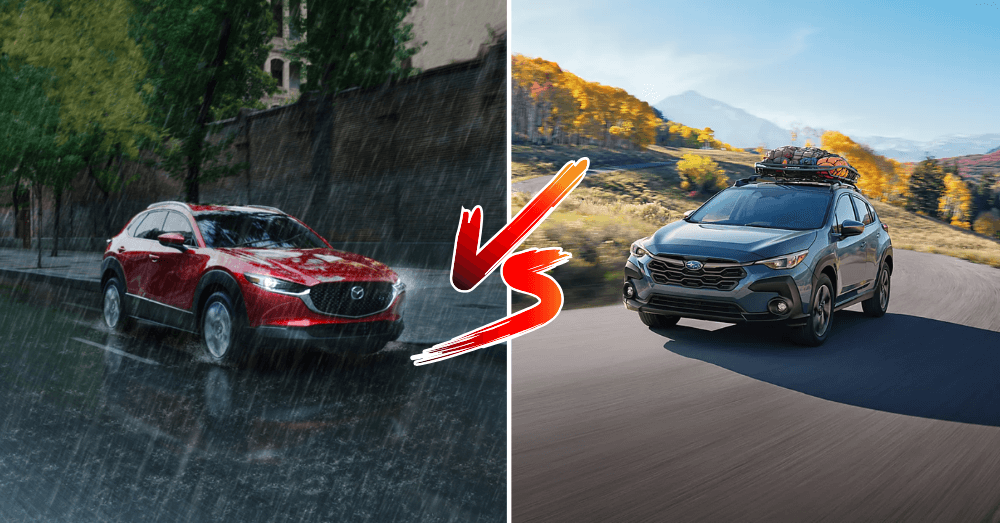
Most compact crossovers feel like appliances on wheels, but the 2025 Mazda CX-30 and Subaru Crosstrek actually deliver some excitement. The CX-30’s turbo engine can genuinely surprise you with its punch, while the Crosstrek keeps you moving fast when roads get sketchy. Both prove you don’t have to settle for boring just because you need practical.
- Speed King: The Mazda CX-30 Turbo hits 60 mph in just 6.2 seconds with 250 horses under the hood
- Corner Carver: Mazda’s sporty suspension makes the CX-30 feel like a hot hatch that grew up
- All-Weather Warrior: Subaru’s 8.7 inches of ground clearance and smart AWD keep you flying when others slow down
The CX-30 Turbo Actually Moves
Here’s what shocked me about the 2025 Mazda CX-30: this thing is genuinely quick. We’re talking 6.2 seconds to 60 mph with the turbo engine, which puts it ahead of plenty of cars that cost twice as much. That’s faster than a Volkswagen Golf GTI, and this is supposed to be a practical family hauler.
The secret sauce is the 2.5-liter turbo that cranks out 250 horsepower and 320 lb-ft of torque. What makes it feel even faster is how that power hits, peak torque comes on at just 2,500 rpm, so you get immediate response when you step on it. No waiting around for the engine to wake up.
Even if you skip the turbo, the base CX-30 packs more punch than most. The standard 2.5-liter makes 191 horsepower, which is the strongest base engine you’ll find in this class. It’ll still get you to 60 mph in about 8 seconds, which beats most of its naturally-aspirated competitors.
Drive one back-to-back with a typical crossover and you’ll immediately feel the difference. Where others feel sluggish pulling onto highways or climbing hills, the Mazda CX-30 just goes. No drama, no waiting, just smooth, confident acceleration.
Handling That Actually Works
Speed isn’t just about straight-line acceleration. The CX-30 proves this when you hit the first corner. This crossover handles like Mazda took their excellent Mazda3 and just lifted it a few inches.
The steering responds exactly when you want it to, without that vague, disconnected feeling you get in most SUVs. Body roll stays minimal even when you’re really pushing it. The suspension strikes this sweet spot where it’s firm enough to keep things controlled but soft enough that your daily commute doesn’t beat you up.
Testing showed the CX-30 pulled 0.83 g on the skidpad and stopped from 70 mph in 174 feet. Those numbers would be impressive for a sports car, let alone a practical crossover. You can actually have fun driving this thing on a twisty back road.
Compare that to the typical crossover experience where cornering feels like steering a refrigerator, and the CX-30’s party trick becomes obvious. It’s one of the few crossovers where “fun to drive” isn’t just marketing speak.
Subaru’s Take on Fast
The 2025 Subaru Crosstrek defines speed differently. Instead of raw acceleration, it focuses on never having to slow down. While the CX-30 might leave it behind on smooth pavement, the Crosstrek keeps moving when conditions get tough.
The base Crosstrek makes do with 152 horsepower from a 2.0-liter engine, which feels pretty anemic. Most buyers will want the 2.5-liter with 182 horsepower, but even that takes about 8.1 seconds to hit 60 mph. On paper, it’s clearly slower than the Mazda.
But here’s where Subaru’s philosophy pays off: this thing just keeps going. Snow, gravel, muddy trails, the Crosstrek maintains its pace when other vehicles start tiptoeing around. The 8.7 inches of ground clearance and Subaru’s smart all-wheel-drive system mean you can carry speed through conditions that would force others to crawl.
I’ve driven the Crosstrek through everything from mountain passes in Colorado to Michigan winters, and it’s impressive how confidently it handles sketchy conditions. That’s a different kind of speed, the ability to maintain momentum when the road gets challenging.
Real-World Trade-offs
The CX-30’s performance comes with some compromises. The turbo engine drinks premium fuel and returns 22 mpg city, 30 highway. That’s decent but not great. The base engine does better at 26 city, 33 highway.
The Crosstrek prioritizes efficiency. The base 2.0-liter gets 27 city, 34 highway, while the more powerful 2.5-liter drops to 26 city, 33 highway. Both use a CVT that prioritizes smoothness over sportiness.
Space differs too. The Crosstrek offers 54.7 cubic feet of cargo space with the rear seats down, compared to the CX-30’s 45.2 cubic feet. If you haul a lot of gear, Subaru’s got the edge.
The CX-30 makes up for it with interior quality. The cabin feels more upscale, with better materials and a more driver-focused layout. It’s the nicer place to spend time, even if it’s a bit tighter.
Which One Fits Your Speed Style?
Both crossovers prove that practical doesn’t have to mean boring, just in different ways.
Pick the CX-30 if you want genuine driving thrills. The turbo version delivers sports car acceleration in a practical package, and the handling makes every drive more engaging. It’s the choice for drivers who still want to feel connected to their car.
Go with the Crosstrek if you value capability over pure speed. It might not win any drag races, but it’ll keep you moving when conditions deteriorate. For outdoor enthusiasts or anyone dealing with harsh weather, Subaru’s approach makes more sense.
Both represent a huge step forward for compact crossovers. You no longer have to choose between practical and fun, you just have to decide which type of fun appeals to you more.